





 Trump-Backed Crypto Firm Takes Step Toward Federal Banking Oversight
  Article Contributors

 Fact checked by

Scaling the USD1 Ecosystem
The proposed trust bank would be designed to issue, custody, redeem, and convert USD1, the dollar-pegged stablecoin that World Liberty launched in March 2025.
According to company disclosures, USD1 has grown rapidly since its introduction, exceeding $3.3 billion in circulating supply within its first year. This places it among the more substantial stablecoins by outstanding market value.
If approved, the national trust bank would bring under one federal charter key functions that World Liberty currently performs with third-party providers.
The company stated that the charter would allow for fee-free minting and redemption of USD1, institutional custody services, and on-ramp/off-ramp conversion services between U.S. dollars and the stablecoin.
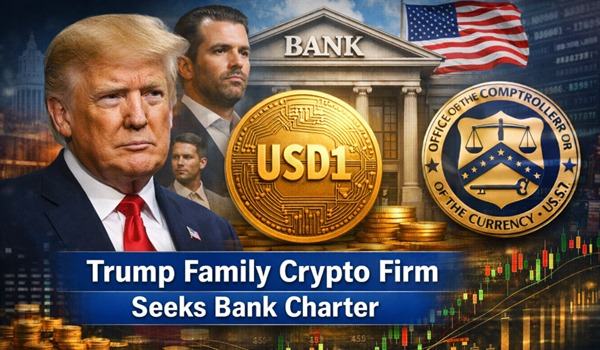
In its press release, World Liberty stated the trust would initially target institutional customers, including cryptocurrency exchanges, market makers, and investment firms.
These clients often face higher regulatory scrutiny and demand transparent compliance frameworks before integrating digital assets into treasury and settlement operations.
World Liberty’s leadership framed the charter application as part of a broader strategy to simplify infrastructure and reduce reliance on external custodians. “A national trust charter will allow us to bring issuance, custody, and conversion together under one highly regulated entity,” said Zach Witkoff, co-founder and proposed president and chairman of World Liberty Trust Company.
- Several cryptocurrency firms have already moved to secure trust bank charters or filed applications. Conditional OCC approvals were issued to entities including Circle, Ripple, BitGo, Fidelity Digital Assets, and Paxos.
Coinbase and Crypto.com are among those awaiting final decisions. Currently, Anchorage Digital remains the only digital-asset firm operating under a fully approved national trust charter.
Under federal trust bank rules, the charter would not permit the new entity to take retail deposits or engage in traditional loan making.
Instead, its business model will concentrate on digital asset custody, stablecoin issuance, and payment operations, functions that increasingly blur the lines between conventional banking and digital finance.
USD1’s Place in the Stablecoin Ecosystem
World Liberty’s USD1 stablecoin is pegged 1:1 to the U.S. dollar and backed by reserves held in regulated financial institutions and short-duration U.S. government securities. The stablecoin is designed for cross-border payments and settlement, offering a digital dollar alternative that proponents say could streamline corporate treasury operations.
The project’s expansion comes at a time when stablecoins are moving beyond trading markets into real-world financial use cases. USD1 has been added to the listing roadmaps of major exchanges, signaling broader accessibility.
World Liberty Financial was launched in late 2024 by President Trump alongside his sons and key executives. Public statements and disclosures confirm that the venture is closely linked to the Trump family, with roles ranging from co-founder emeritus to executive leadership.
The charter application adds another chapter to the U.S. government’s evolving approach to digital assets, juxtaposing private crypto innovation with federal supervision.
Industry observers note that federally chartered stablecoin banks could expand institutional participation by providing clearer compliance standards.
However, they also raise questions about the potential for a dual-track financial system where trust banks operate alongside traditional commercial banks.
Next Steps and Industry Implications
The OCC review process for a national trust bank charter is thorough and can extend over several months, during which regulators scrutinize business plans, risk management frameworks, and compliance capabilities. World Liberty Financial has stated its intent to comply with all regulatory requirements, including those established under the GENIUS Act.
For World Liberty, securing a federal charter represents a critical step toward integrating its stablecoin into regulated finance infrastructure. Approval could strengthen the institution’s appeal to conservative institutional capital and position USD1 as a bridge between digital asset networks and traditional payment systems.
The outcome will be closely watched by both crypto investors and mainstream financial institutions as the role of stablecoins in the U.S. financial system continues to evolve.


 eabungana@gmail.com
