





 Bitcoin Free Fall: Mayday Signals Flash as Crypto’s $2 Trillion Rout Deepens
  Article Contributors

 Fact checked by


The Leverage Flush: A Mechanical Collapse
The speed of the decline exposed how fragile the market had become after months of leverage-driven optimism. According to Coinglass, roughly $2 billion in crypto positions were liquidated on February 5 alone, with nearly 80 percent tied to long bets.
Bitcoin’s break below the closely watched $70,000 level triggered a cascade of forced selling across derivatives exchanges, overwhelming spot demand and accelerating losses within minutes. Market participants widely described the episode as a classic leverage flush, though the scale was far larger than most anticipated.
At its core, the crash was mechanical. During the latter stages of the 2025 rally, leverage across major crypto venues surged, with some traders operating at 50x to 100x multiples. When prices began to slide, margin calls hit in waves.
Within hours, liquidations exceeded $2.6 billion, ranking among the largest one-day wipeouts since centralized exchange failures reshaped the market three years ago. Volatility metrics spiked to levels last seen during the FTX crisis, underscoring how quickly sentiment flipped from complacency to panic.
Macro Headwinds and the “Warsh Shock”
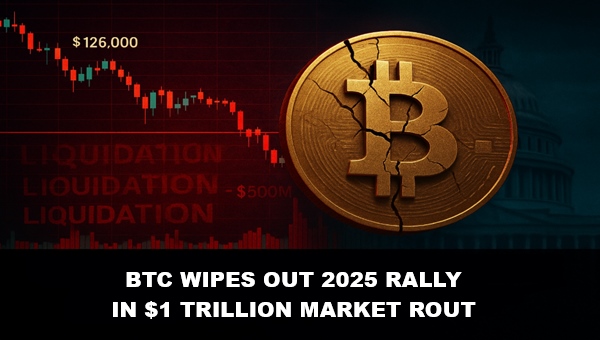
Bitcoin has now lost more than half its value in just over three months, dragging total crypto market capitalization down by an estimated $2 trillion since October. Ethereum slid toward $1,900, while major altcoins, including Solana and XRP, posted double-digit daily declines at the height of the rout.
What had been a market fueled by post-election optimism and expectations of regulatory thaw has collided head-on with tightening financial conditions.
Macroeconomic pressure has been central to the shift. U.S. equity markets weakened sharply this week, particularly technology stocks, after disappointing earnings reports and a January labor market update that reinforced concerns about slowing growth without cooling inflation.
Bitcoin, which had spent much of 2025 trading as a perceived hedge, moved in lockstep with risk assets. As Treasury yields remained elevated and the dollar strengthened, capital rotated away from speculative exposures.
Federal Reserve policy expectations added further strain. The nomination of Kevin Warsh as Fed chair hardened investor assumptions that interest rates will stay higher for longer. With the benchmark rate holding between 3.50 percent and 3.75 percent and inflation running at approximately 3.4 percent, hopes for aggressive rate cuts in 2026 have largely faded.
In that environment, assets prone to deep drawdowns struggle to compete with predictable yields offered by cash and short-dated government debt.
Institutional Retreat and Miner Capitulation
Institutional flows, once seen as Bitcoin’s stabilizing force, also turned decisively negative. U.S. spot Bitcoin exchange-traded funds recorded notable net outflows throughout the week as asset managers reduced exposure and shifted toward traditional defensive assets such as gold and Treasuries.
The reversal undermined a key pillar of demand that had supported prices during earlier pullbacks.
Even companies synonymous with corporate Bitcoin accumulation were not immune. Shares of Strategy Inc., which holds more than 700,000 BTC, fell sharply as Bitcoin slipped below the firm’s reported average acquisition cost of roughly $76,000 per coin.
Stress is now rippling through the mining sector as well. On-chain data shows several large miners transferring Bitcoin to exchanges and counterparties, a move commonly associated with liquidity management.
Estimated average production costs sit near $87,000 per Bitcoin, placing current prices well below breakeven for many operators. When miners are forced to sell reserves to fund operations, additional supply enters an already fragile market, reinforcing downward momentum.
Fear Indicators and the Path to $50,000?
Geopolitical uncertainty has compounded the pressure. Recent tensions involving the United States and Iran prompted a flight toward the U.S. dollar and sovereign bonds, leaving cryptocurrencies sidelined.
While Bitcoin has often been framed as a hedge during geopolitical stress, recent price action suggests investors continue to treat it as a high-risk asset that is sold first when uncertainty spikes.
Sentiment indicators reflect the severity of the shift. The widely followed Fear and Greed Index plunged to a reading of 5, firmly in “extreme fear” territory.
Stablecoin data points to shrinking dry powder, with estimates suggesting roughly $14 billion in net outflows between December and early February. That contraction signals caution rather than readiness to deploy capital at lower levels.
As markets digest the damage, attention is turning to whether the $60,000 area can hold as a durable floor.
BiteEdge analysts point to zones near $52,000 as the next area of interest if selling resumes, though conviction remains thin. For now, the rapid descent has silenced dip-buyers and reframed the narrative.
BTC Crash Breakdown: Main Points
| Bitcoin Price | Dropped from $73k to ~$60k-64k range on Feb 5. |
| Liquidations | Over $2B in total crypto liquidations reported. |
| Strategy Inc. | Holds ~710k BTC; average cost is ~$76k. |
| Fed Chair | Kevin Warsh nominated; market views him as hawkish. |
| Fear Index | Extreme Fear (single digits) reflects the current panic. |
Related News


 eabungana@gmail.com
He has worked with several companies in the past including Economy Watch, and Milkroad. Finds writing for BitEdge highly satisfying as he gets an opportunity to share his knowledge with a broad community of gamblers.
Nationality
Kenyan
Lives In
Cape Town
University
Kenyatta University and USIU
Degree
Economics, Finance and Journalism


Facts Checked by Josip Putarek