





 U.S. Treasury Warns Crypto ATMs Are Becoming a Major Fraud Gateway
  Article Contributors

 Fact checked by

Surging Losses and High-Frequency Scams
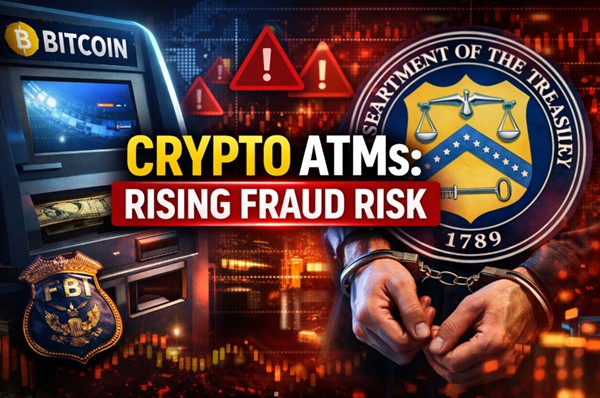
The warning reflects mounting concern across U.S. law enforcement and financial regulators that the rapid expansion of crypto ATMs has created a payment channel particularly vulnerable to scams.
While the machines offer convenience for users who want to convert cash into digital assets, investigators say criminals have learned to exploit their speed and limited oversight.
Law enforcement data shows the scale of the problem expanding quickly. The FBI received more than 10,900 complaints related to crypto ATM scams in 2024, with reported losses totaling about $246.7 million, according to figures referenced in the Treasury assessment. The trend has continued to accelerate.
Investigators reported that Americans lost roughly $333 million through Bitcoin ATM related scams in 2025, underscoring how rapidly the fraud category is expanding as the number of machines grows. The United States now hosts more than 30,000 crypto ATMs, accounting for the majority of such machines worldwide.
The Mechanics of Exploitation
Crypto ATMs allow users to deposit cash and convert it into digital assets such as Bitcoin, typically by scanning a wallet QR code. The process can take only minutes and often requires limited identity verification depending on transaction size and the policies of the operator.
Treasury officials say that speed and simplicity have made the machines attractive not only to legitimate users but also to fraud networks. Scammers frequently instruct victims to withdraw cash and deposit it into a crypto ATM, directing the funds to wallets controlled by criminals. Once transferred, the transactions are irreversible.
Investigators say the scams often begin with impersonation schemes. Victims may receive phone calls or online messages from individuals posing as bank representatives, government agencies, or technology support services. They are told their accounts have been compromised and that immediate action is needed to secure their money.
In these cases, the victim is guided step by step through the process of depositing funds into a crypto ATM. The funds are then converted to cryptocurrency and sent to addresses controlled by fraudsters, making recovery extremely difficult.
Law enforcement agencies note that older individuals are particularly vulnerable to these schemes. In some investigations, victims have transferred hundreds of thousands of dollars under pressure from scammers posing as officials or financial advisers.
For investigators, crypto ATM scams represent a convergence of two broader trends. One is the rising sophistication of online fraud networks, including operations linked to organized crime groups. The other is the increasing integration of digital assets into everyday financial infrastructure.
Treasury Flags Broader Crypto Risks
The Treasury report places crypto ATM fraud within a larger framework of digital asset risks. Officials highlighted several tools that criminals use to obscure the movement of stolen funds after initial transfers.
These include cryptocurrency mixers, decentralized finance platforms, and cross-chain bridges that allow assets to move between blockchains. Such tools can make it more difficult for investigators to trace transactions or freeze illicit funds once they have entered the digital asset ecosystem.
At the same time, the report also points to emerging technologies that could strengthen oversight. Blockchain analytics platforms are increasingly used by financial institutions and law enforcement agencies to trace suspicious transactions and identify networks of wallets associated with scams.
Digital identity systems and artificial intelligence-driven monitoring tools are also being explored as potential solutions for improving compliance with anti-money laundering regulations.
Regulators say these technologies could help financial institutions detect suspicious patterns more quickly, particularly when combined with stronger reporting requirements for money transmitters and digital asset service providers.
Growing Regulatory Attention
Over the past several years, regulators have expanded their focus from exchanges and trading platforms to the wider infrastructure supporting crypto transactions.
Crypto ATMs have become part of that conversation as their numbers increase and fraud cases accumulate. Some local governments in the United States have already begun considering restrictions or transaction limits for kiosk operators in response to scam reports.
Law enforcement agencies have also pursued criminal cases involving crypto ATM fraud rings, including schemes that targeted elderly victims and resulted in losses reaching into the millions of dollars.
For regulators, the challenge lies in balancing innovation with consumer protection. Crypto ATMs provide a simple entry point for users who may not have access to traditional exchanges or banking services. At the same time, officials say safeguards must evolve as criminals adapt their tactics.
The Treasury report suggests that without stronger oversight and improved monitoring tools, crypto ATMs could remain a persistent gateway for financial fraud within the expanding digital asset economy.


 eabungana@gmail.com
