





 Nexo Charges Back into U.S. Crypto Scene as Regulations Thaw
  Article Contributors

 Fact checked by

Institutional Partnerships and Regulatory Realignment
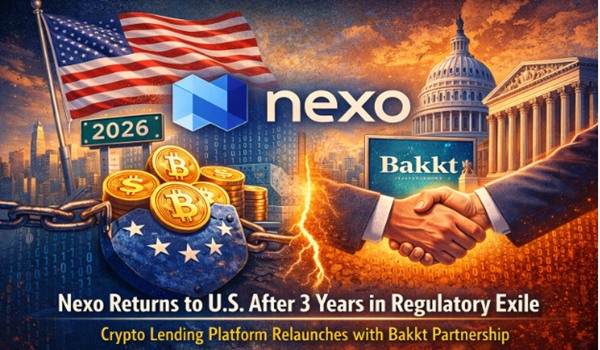
Behind the scenes, trading and custody infrastructure are powered by Bakkt, the publicly traded digital asset firm known for institutional-grade risk management and custody services.
Nexo says the relaunch operates through licensed partners, including an SEC-registered investment adviser where required. Company representatives stress that this structure differs fundamentally from its earlier U.S. model.
That earlier chapter ended under pressure. In late 2022, Nexo withdrew from the U.S. as tensions with regulators intensified. The breaking point came in 2023, when the company agreed to a 45 million dollar settlement with the U.S. Securities and Exchange Commission and state authorities.
Regulators argued that Nexo’s Earn Interest Product should have been registered as a security under the Howey test. Without admitting or denying the findings, Nexo phased out the product for U.S. users by April 2023.
Navigating the Post-Crisis Landscape
The retreat unfolded during a wider industry crisis. Crypto lenders such as Celsius Network and BlockFi collapsed into bankruptcy, locking up billions in customer funds and exposing weaknesses in high-yield lending models. For many firms, exiting the U.S. became a defensive move.
A January 2025 executive order from President Donald Trump directed federal agencies to promote digital financial leadership and move away from what critics had described as regulation through enforcement. Later that year, Congress passed the Guiding and Establishing National Innovation for U.S. Stablecoins Act, known as the GENIUS Act.
The law established a federal framework for dollar-backed stablecoins, setting reserve, attestation, and redemption standards that brought greater clarity to a market exceeding 150 billion dollars globally.
The 2025 Regulatory Pivot
The Digital Asset Market Clarity Act of 2025 further defined the roles of the SEC and the Commodity Futures Trading Commission, placing certain non-security digital commodities under CFTC oversight.
The SEC also withdrew Staff Accounting Bulletin 121 and replaced it with updated guidance that eased custody treatment for banks handling digital assets.
In December 2025, the Office of the Comptroller of the Currency approved several national trust bank charters for crypto firms, reflecting a more open stance toward the sector.
Nexo’s return coincides with this shift. The company reports 11 billion dollars in assets under management as of late 2025 and more than 371 billion dollars in transactions processed globally since 2018.
Data from CryptoQuant shows roughly 863 million dollars in loans issued between January 2025 and January 2026, with more than 30 percent repaid during periods of market stress, which Nexo cites as evidence of tighter risk controls.
Leadership, Politics, and Persistent Legal Hurdles
Co-founder Antoni Trenchev, a former Bulgarian lawmaker, has positioned the company as part of crypto’s institutional evolution. His meetings with President Trump and appearances alongside members of the Trump family have drawn attention, though Nexo maintains that its regulatory progress stems from compliance changes rather than political ties.
Challenges are not absent. On January 14, 2026, California’s Department of Financial Protection and Innovation imposed a 500,000 dollar penalty on Nexo for unlicensed lending activity between 2018 and 2022.
The action underscored that legacy issues can resurface even as the regulatory environment evolves.
Debates across the industry continue as well. Tokenized collateral, decentralized finance oversight, and stablecoin reserve enforcement remain active topics for regulators.
Implementation rules under the GENIUS Act are expected later in 2026 and could further refine compliance obligations.
The Future of Yield in a Maturing Market
Nexo’s reentry serves as a test case for the sector’s reset. The global crypto lending market, valued at 10.68 billion dollars in 2025 and projected to reach 25 billion dollars by 2030, presents a significant opportunity.
Fixed-yield products, in some cases advertised at up to 12 percent on select assets, may appeal to investors seeking steadier returns while bitcoin trades near 70,000 dollars and ether staking yields range between 4 and 6 percent annually.
Volatility, however, remains inherent to digital assets. The 2022 downturn erased roughly 2 trillion dollars in market value, and regulatory standards continue to evolve. Nexo’s strategy rests on the assumption that stronger compliance, institutional infrastructure, and clearer rules can translate into durable trust.
Its return highlights that the United States, once viewed by many crypto firms as a legal hazard, is positioning itself as a more structured environment for digital finance.


 eabungana@gmail.com
