





 EU Moves to Sever Russian Crypto Links as Moscow Expands Mining Power
  Article Contributors

 Fact checked by

From Targeted Bans to a Total Crypto Blockade
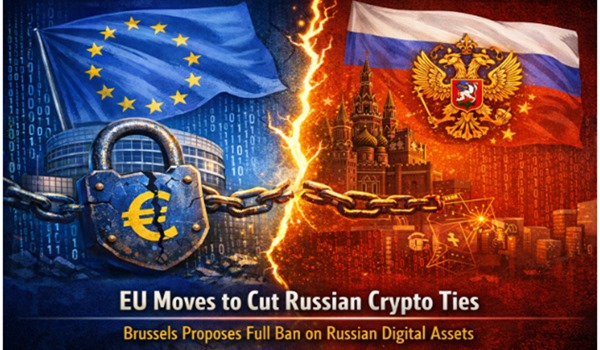
Internal European Commission documents, reviewed by the Financial Times in February 2026, detail the shift from targeting specific sanctioned platforms to a blanket restriction.
Previous strategies were ineffective as blacklisted entities like Garantex reemerged under new names such as Grinex, allowing them to continue operations. The new proposal explicitly bars EU individuals and companies from engaging with Russia-based crypto services or using platforms that facilitate transfers and exchanges linked to Russia.
The ban needs unanimous approval from all 27 member states, and negotiations are ongoing. Some capitals may resist, which could delay implementation.
Discussions intensified as the conflict neared its fourth anniversary on February 24, 2026. If enacted, the prohibition would expand on restrictions introduced in late 2025, limiting crypto services to Russian nationals, closing what officials describe as a critical loophole in the sanctions regime.
Evasion Tactics and the Global Shadow Flow
This move responds to documented evasion patterns. Networks have enabled substantial flows outside regulated banking, including stablecoins and OTC trading that connect Russian actors to partners in Asia and beyond.
The TRM Labs 2026 Crypto Crime Report highlighted Russia-linked activity as a major driver of illicit crypto volumes in 2025, with structures processing billions in restricted transactions.
Russia’s Strategic Pivot to Industrial Mining
In sharp contrast, Russia is integrating cryptocurrency mining into its economy, viewing it as a strategic asset for generating revenue and bolstering the ruble amid isolation.
Legalized through legislation signed by President Putin in August 2024, the sector has expanded aggressively. Russia held approximately 16.4% of the global Bitcoin hash rate, around 175 exahashes per second, in early 2026, securing its position as the second-largest mining nation behind the United States at 37.5%, according to Hashrate Index data from Q1 2026.
This dominance arises from low energy costs, abundant natural gas, hydroelectric power, and favorable climates in regions like Siberia. In 2025, Russian miners produced an estimated 26,000 Bitcoin, generating approximately $2.2 billion in value based on that year’s average prices. Globally, miners extracted around 162,000 Bitcoin in 2025.
Daily cryptocurrency turnover in Russia averages around 50 billion rubles, approximately $650 million, with annual volumes surpassing $130 billion, much of it through local channels.
Financial Integration and the Infrastructure Strain
Russians held nearly $12 billion on global exchanges as of mid-2025 data from the Bank of Russia. Deputy Finance Minister Ivan Chebeskov has cited these figures to illustrate the market’s scale.
In February 2026, broker Finam registered Russia’s first regulated cryptocurrency mining investment fund with the Bank of Russia, channeling capital into large-scale operations such as gas-powered facilities in Mordovia.
This fund allows qualified investors to gain exposure to mining revenues without holding digital assets directly. Shares are expected to begin trading soon, marking a step toward mainstreaming the sector.
A broader regulatory framework is slated for full implementation by July 2026, with retail access expanding from 2027 and limits for non-qualified investors.
The Central Bank of Russia has recognized the role of mining in strengthening the ruble through foreign currency inflows from digital asset exports. However, rapid growth has strained infrastructure. Energy consumption issues have led to bans in over 10 regions, with permanent restrictions in areas such as Buryatia and Zabaykalsky Krai, extending to 2031 in some instances.
Illegal mining has inflicted annual losses of billions of rubles on state grid operator Rosseti, leading to proposed harsher penalties, including up to two years of forced labor for large-scale unregistered operations starting in 2027.
Digital Finance as a Geopolitical Battlefield
The EU views crypto as a sanctions vulnerability that undermines efforts to isolate Russia’s economy and military funding. Brussels aims to raise evasion costs, potentially fragmenting global liquidity and pushing activity to offshore jurisdictions. Enforcement faces hurdles from blockchain’s pseudonymity and intermediary layers, though transparency aids tracking in many cases.
Russia, meanwhile, leverages mining for economic resilience, converting surplus energy into exportable value and fostering innovation in regulated products. Projections suggest hash rate recovery to levels supporting 2.1-2.2 gigawatts of capacity by the end of 2026, driven by self-generated power and efficiency upgrades.
This confrontation positions digital assets at the core of financial geopolitics. The EU seeks to sever channels that erode sanction pressure, while Moscow embeds crypto infrastructure for long-term autonomy. The proposal’s success depends on member-state unity, but Russia’s entrenched mining base indicates digital finance will persist as a key arena in the ongoing standoff.


 eabungana@gmail.com
