





 NYSE Sets Up Blockchain Platform for Round-the-Clock Trading
  Article Contributors

 Fact checked by

24/7 Trading and the Shift to Real-Time Settlement
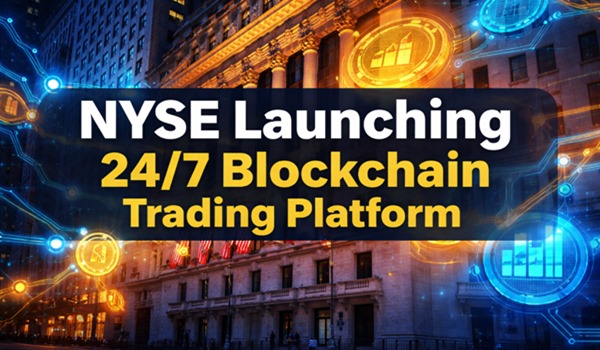
The platform will enable investors to trade tokenized representations of U.S.-listed stocks and exchange-traded funds (ETFs) outside traditional trading hours.
While the regular NYSE operates Monday through Friday, 9:30 a.m. to 4:00 p.m. Eastern Time, the blockchain-enabled venue will allow transactions around the clock, mirroring the continuous nature of cryptocurrency markets.
According to ICE, this model aims to deliver faster settlement, reduce operational friction, and attract a broader class of investors who seek real-time access.
The concept of tokenized securities is not new, but NYSE’s approach is significant due to its scale and regulatory credibility. Tokenization converts traditional assets into digital tokens on a distributed ledger, which can represent shares of a company or units of an ETF.
This allows instantaneous recording of ownership changes on-chain, potentially reducing settlement times from two business days to near real-time.
Early pilot programs suggest that settlement efficiency could improve by 40 to 60 percent, a figure that, if realized at the NYSE scale, would be transformative for institutional and retail participants alike.
Integration with Global Banking and Stablecoin Liquidity
According to the NYSE’s business announcement, trades on the new venue will be denominated in U.S. dollars and can be funded using stablecoins. The exchange plans to combine its established Pillar matching engine with blockchain post‑trade accounting systems that support settlement and custody across multiple chains.
- Token holders will retain dividends and governance rights equivalent to traditional shareholders.
NYSE’s parent ICE is collaborating with major banks such as Bank of New York Mellon and Citigroup to support tokenized deposits across its global clearinghouses, aiming to facilitate funding, margin management, and cross‑border transactions without reliance on conventional banking hours.
Navigating the Regulatory Landscape and Market Competition
U.S. regulators are still reviewing the proposal. The rollout will be subject to approval by the U.S. Securities and Exchange Commission (SEC), a hurdle that has slowed previous digital asset initiatives. NYSE is positioning the platform as a new venue within its regulated framework, not a replacement for the existing exchange.
Bitedge experts view the initiative as part of a trend sweeping global securities markets. In December 2025, the SEC granted The Depository Trust Company a No‑Action Letter to offer tokenization services for major indices and ETFs, allowing certain digital representations under federal securities laws.
That decision indicates regulators are increasingly open to blockchain‑enabled market services if investor protections remain intact.
Some traditional equity exchanges are pursuing similar innovations. Nasdaq, for example, filed a formal proposal with the SEC in 2025 to permit blockchain trading of tokenized stocks on its platform, though under a T+1 settlement regime that retains existing post‑trade processing.
Expert Perspectives and Technical Challenges
Institutional voices have responded with cautious optimism. Duke University economist Campbell Harvey described tokenized stocks as a promising application of distributed ledgers that could bridge legacy markets and new digital ecosystems. His perspective underscores that blockchain’s potential lies in transparency, efficiency, and global market access.
Retail and crypto‑native communities have also reacted. Changpeng Zhao, former CEO of Binance, said on social media that NYSE’s tokenization initiative was “bullish for crypto and crypto exchanges,” reflecting the industry’s belief that regulatory approval of tokenized markets could expand digital assets’ investor base.
Despite the enthusiasm, not all experts are convinced. Omid Malekan, a professor at Columbia Business School, criticized the announcement’s lack of technical detail, calling it akin to “vaporware” because the NYSE has not disclosed which blockchain or tokenomics model it will use, nor how multi‑chain settlement and permissioning will operate in practice.
- Global regulatory bodies have expressed concerns about tokenization risks beyond execution and settlement.
The International Organization of Securities Commissions (IOSCO) reported that digital asset tokens linked to real‑world securities could introduce new vulnerabilities over and above existing frameworks, such as technology fragility and governance complexities.
The Data
Comparative data from the broader tokenized markets shows demand for 24/7 access.
Independent platforms like xStocks, which operates an always‑on trading venue for tokenized equities, recently reported having surpassed $17 billion in total trading volume, demonstrating strong market appetite for borderless, continuous trading.
- There is a need for a robust post‑trade ecosystem if NYSE’s platform is to succeed.
- Tokenized markets require integrated custody, compliance layers, and risk controls.
These systems must mirror those used in traditional markets. Building them is a complex engineering challenge that involves more than simply enabling blockchain settlement.
Successfully addressing these issues will determine whether tokenized markets gain institutional legitimacy or remain niche offerings.




 eabungana@gmail.com
