





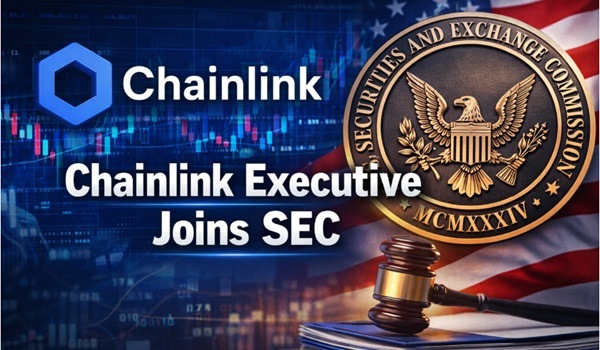
 Taylor Lindman, Chainlink Exec, Joins SEC Crypto Force
  Article Contributors

 Fact checked by

A Strategic Shift: Filling the SEC’s Regulatory Vacancy
The appointment fills a vacancy left by Michael Selig, who departed in December 2025 to chair the Commodity Futures Trading Commission. SEC Commissioner Hester Peirce, affectionately known as “Crypto Mom” for her advocacy of balanced regulation, confirmed the news with enthusiasm.
She posted on X, predicting “great things” from Lindman’s contributions. Chainlink Labs echoed the sentiment in its own statement, thanking Lindman for his tenure and expressing optimism about collaborating to modernize the U.S. financial system.
Such cross-pollination between industry and regulators marks a departure from past tensions, where enforcement actions often overshadowed dialogue.
From the Trenches: Lindman’s Technical Expertise
Lindman’s background equips him uniquely for this challenge. A 2016 graduate of the University of Pennsylvania Carey Law School, he began his career at Debevoise & Plimpton LLP, honing skills in corporate law before diving into blockchain at Chainlink.
As deputy general counsel, he advised on regulatory compliance for smart contracts, oracle networks, and enterprise integrations. His expertise spans the technical trenches of DeFi, where Chainlink’s oracles have enabled over 19.14 billion verified messages and secured $62.62 billion in total value.
This hands-on experience addresses a longstanding industry complaint: Regulators simply don’t grasp the technology they’re policing.
The Task Force’s Mission: Defining the Digital Asset Framework
The Crypto Task Force was launched in January 2025 by Acting Chairman Mark Uyeda to craft a “comprehensive and clear regulatory framework” for digital assets. Under Peirce’s leadership, the task force has shifted from the enforcement-focused era of former Chair Gary Gensler to one emphasizing collaboration.
It has hosted roundtables on tokenization and DeFi, solicited public input, and coordinated with other agencies like the CFTC. Priorities include clarifying what constitutes a security under the Howey test, providing registration paths for crypto firms, and developing tailored disclosure rules.
Lindman’s role will involve interpreting laws for investigators, guiding compliance, and influencing enforcement decisions.
Market Impact and Chainlink’s Institutional Footprint
For Chainlink, Lindman’s departure and his new position inside the SEC carry both immediate market signals and deeper strategic weight. The oracle network, which facilitates real-world data for smart contracts, has seen explosive growth.
Its Transaction Value Enabled metric reached $28.42 trillion by February 2026, reflecting integrations with institutions like SWIFT, DTCC, Ondo Finance, Robinhood, and the Bank of England.
Recent expansions include nine new testnet blockchains and upgrades to Data Streams for near-real-time feeds, enabling tokenized stocks and indices.
The Chainlink Reserve now holds over 2.17 million LINK tokens, creating buy pressure tied to network revenue.
Following Lindman’s appointment, LINK’s price rebounded from $8.13 to $8.27, a 1.7% gain in 24 hours, though it remains down 51% year-over-year amid broader market volatility.
Navigating Reform: Innovation vs. Oversight
Yet, the appointment’s true impact lies in its potential to reshape regulation. Lindman’s DeFi knowledge could inform guidance on oracle-dependent protocols, where data accuracy underpins trillions in value.
Consider tokenization: As firms like UBS and FTSE Russell publish on-chain data, clearer rules might accelerate the shift of $10 trillion in traditional assets to blockchains.
This could mitigate risks seen in past collapses, like the $40 billion Terra-Luna debacle in 2022, by emphasizing technical compliance over punitive measures. Analysts suggest it might influence ongoing cases, such as the SEC’s suits against major exchanges, by advocating for nuanced interpretations that distinguish utility tokens from securities.
Critics, however, caution against overoptimism. Some worry Lindman’s industry ties could lead to lax enforcement, potentially exposing investors to fraud in a market still rife with scams. Others point to jurisdictional overlaps with the CFTC, as seen in recent prediction market disputes.
The Ninth Circuit’s February 17, 2026, ruling denied a pause on Nevada’s block of event contracts, prompting the CFTC to assert exclusive authority in an amicus brief. Such turf battles highlight the need for coordinated policy, which Lindman might help facilitate through Project Crypto, the inter-agency initiative.
What Comes Next?
Lindman’s tenure could act as a catalyst for innovation while still protecting markets. If the CLARITY Act passes by mid-2026 as anticipated, it would establish clearer boundaries and lower compliance costs that have discouraged institutional participation.
Alongside the SEC’s consideration of an “innovation exemption”, effectively a sandbox for testing products under lighter rules, and a proposed “super app” license enabling comprehensive securities activities, the framework could open the door to broader adoption.
The crypto community is watching closely and hopes this insider perspective transforms regulatory headwinds into tailwinds.


 eabungana@gmail.com
