





 UK Stops Crypto Donations
  Article Contributors

 Fact checked by

The Rycroft Review and Immediate Policy Shifts
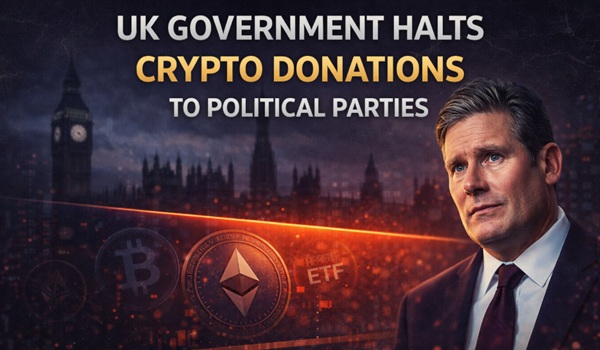
The announcement follows the release of the Rycroft review, delivered the same day. Philip Rycroft, a former senior civil servant, examined foreign financial interference in UK politics after the government commissioned the work in December 2025.
Ministers accepted two of his main recommendations without delay: the crypto pause and a new £100,000 annual cap on donations from British citizens living overseas. Both changes will be added to amendments in the Representation of the People Bill now before Parliament.
Reform UK stands out as the only major party to have accepted crypto gifts. Leader Nigel Farage said in May 2025 that the party would take Bitcoin and other digital assets. By October 2025, he confirmed it had received a couple of such donations through a Polish payments platform.
None of those reached the £11,180 threshold that requires public declaration to the Electoral Commission.
Smaller parties, including the Homeland Party, also opened the door to crypto but recorded only one small payment of about £27.
The Challenge of Pseudonymous Donations
Electoral Commission data confirm that, as of February 2026, no party had reported any crypto donation above the reporting line. Before today’s pause, crypto was treated as a non-monetary donation.
Parties had to apply the same identity checks required for cash gifts over £500 and return any they could not verify. In practice, the borderless and pseudonymous features of crypto made those checks harder to complete with confidence.
The Rycroft review spelled out the risks in direct terms. Tools such as mixers, tumblers, and privacy coins can hide the origin of funds. Artificial intelligence can split larger sums into multiple payments below key thresholds, including the £500 verification level.
The review described these features as creating an unnecessary and unacceptably high risk to the integrity of political finance. It stopped short of calling for a permanent ban, instead framing the moratorium as time for the Electoral Commission to develop workable rules.
The Road to Statutory Guidance
Under the new approach, parties must return any crypto received from today onward. Once the Electoral Commission produces statutory guidance, likely requiring donations through FCA-registered providers and full proof of beneficial ownership, the pause can end. Parties will have 30 days to comply with the final rules or face criminal penalties.
The overseas donor cap addresses a separate channel. British citizens living abroad who remain on the electoral register previously faced no upper limit on contributions.
The new £100,000 ceiling per donor per year changes that calculation. Reform UK received more than £12 million last year from Christopher Harborne, a British businessman based in Thailand.
That single donor relationship, one of the largest ever recorded from a living individual to a UK party, now exceeds the annual limit.
Aligning Electoral Law with Financial Regulation
These measures fit into a wider tightening of political funding rules. The UK has built a detailed crypto regulatory regime under the Financial Conduct Authority, covering stablecoins and transfer reporting. Political donations, however, follow electoral law that has not kept pace.
The Joint Committee on National Security Strategy had already called for an immediate pause on crypto gifts earlier in March 2026, citing the same traceability gaps.
Security officials have repeatedly flagged attempts by foreign actors, including those linked to Russia, China, and Iran, to influence UK politics through financial channels. The Rycroft report notes a persistent problem but finds no evidence that foreign money distorted the outcome of the 2024 general election.
It warns instead that repeated small vulnerabilities can erode public confidence over time.
The Transparency Debate: Blockchain vs. Offshore
Industry voices in the crypto sector point out that blockchain ledgers can offer permanent records of transactions, potentially more transparent than some traditional offshore vehicles. The review acknowledges the technology’s potential while concluding that enforcement tools have not yet caught up in the specific context of political donations.
For parties, the operational impact is straightforward. Any wallets set up for digital assets will need to be closed or converted into sterling through regulated channels.
The Liberal Democrats have called on Reform UK to return any crypto already accepted from sources that cannot be fully verified. The changes will cover all forthcoming elections, including English local elections in May 2026, the next Scottish Parliament vote, and Senedd elections in Wales.
Housing Secretary Steve Reed said the steps protect democracy by closing off routes for illicit funds.
Future Outlook: Corporate and Digital Advertising
Further recommendations in the Rycroft review, such as limits on company donations and restrictions on foreign-funded online political advertising, remain under consideration.
For now, the focus rests on the crypto moratorium and the overseas cap.


 eabungana@gmail.com
