





 Bitcoin’s War Test: Bulls Fight to Hold $70,000
  Article Contributors

Digital Gold or Risk Asset: The Ongoing Identity Crisis
The recovery has revived a long-running debate among investors: whether Bitcoin is gradually evolving into a form of “digital gold,” or whether it remains primarily a high-risk asset that reacts to geopolitical shocks much like technology stocks.
Warren Buffett once described Bitcoin as “rat poison squared” at the 2018 Berkshire Hathaway shareholder meeting, and critics have often pointed to its tendency to move alongside risk assets during periods of market stress.
Traditional safe havens, by contrast, display several well-established characteristics. They tend to maintain relatively low correlation with equities, derive value from scarcity, and preserve purchasing power during geopolitical and financial upheaval. Gold has built that reputation over centuries of wars, currency crises, and economic disruptions.
Bitcoin, by comparison, has existed for just over fifteen years.
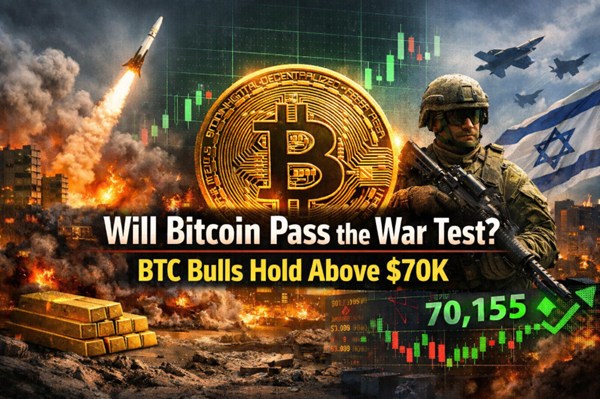
The Volatility Trap: Initial Reactions to Geopolitical Stress
Its behavior during the current geopolitical confrontation, therefore, offers another test of whether the asset is beginning to display some of the resilience historically associated with safe-haven investments.
The initial market reaction suggested otherwise. Derivatives liquidations across cryptocurrency exchanges exceeded $1 billion as the conflict triggered a wave of deleveraging. Analysts warned the sell-off could deepen if geopolitical escalation intensified, with some projecting that Bitcoin could briefly retreat toward $50,000.
For critics, the episode reinforced a familiar argument: assets that decline during the first wave of geopolitical stress struggle to qualify as reliable stores of value.
How ETFs and Long-Term Holders Stabilize Price
However, Bitcoin’s rapid stabilization has prompted some investors to reconsider whether structural changes in the market are altering its crisis behavior.
One of the most significant shifts has been the rise of institutional participation through spot Bitcoin exchange-traded funds. On March 4 alone, net inflows across U.S. spot Bitcoin ETFs reached approximately $456 million, with BlackRock’s fund accounting for the largest share.
Institutional participation has introduced deeper liquidity and stronger price support. During earlier geopolitical shocks, Bitcoin markets were largely dominated by retail speculation and highly leveraged trading activity. Today, regulated investment vehicles allow asset managers, pension funds, and corporations to gain exposure to the asset without navigating complex custody infrastructure.
On-chain data shows long-term holders have largely refrained from selling during the recent bout of volatility, while institutional investors appear to have continued accumulating, reinforcing confidence in Bitcoin’s market structure. Exchange balances edged lower during the initial sell-off, suggesting that large holders were not transferring coins to trading platforms in preparation for liquidation.
The “War Test”: A Pattern of Maturing Market Resilience
Historical precedent provides additional context.
During Russia’s invasion of Ukraine in 2022, Bitcoin initially declined by roughly 10 percent before stabilizing and eventually recovering as governments injected liquidity into global financial systems. A similar pattern appeared during the Israel–Hamas conflict in 2023, when a short-term drop was followed by relatively rapid stabilization in cryptocurrency markets.
The current confrontation carries greater geopolitical uncertainty, yet Bitcoin’s market response has remained comparatively contained. Implied volatility rose to around 45 percent but did not trigger a broader cascade of forced selling.
Institutional adoption also continues to expand. MicroStrategy recently added another 7,000 bitcoins to its holdings, bringing the value of its corporate treasury to more than $22 billion. Meanwhile, policymakers in several jurisdictions have begun discussing whether Bitcoin could eventually play a role in strategic reserve assets.
These developments suggest Bitcoin’s position within the global financial system continues to evolve.
Still, the ultimate test extends beyond any single price level.
Bitcoin’s ability to remain above $70,000 during a period of active geopolitical conflict is notable. The deeper question is whether the asset can consistently preserve value when geopolitical risk intensifies.
What Happens Next?
For now, the evidence points toward gradual market maturation rather than a definitive transformation.
Bitcoin initially behaved like a risk asset when the conflict began. Yet it stabilized quickly, recovered its losses, and continued attracting capital even as tensions escalated. That pattern does not fully replicate gold’s historical behavior, but it marks a shift from Bitcoin’s earlier market cycles.
In its early years, geopolitical shocks often triggered prolonged declines. Today, the market appears increasingly capable of absorbing them.
Whether Bitcoin ultimately earns the title of digital gold will not be decided in a single conflict. That status would require repeated demonstrations of resilience across multiple crises.
But the current episode offers another data point: Bitcoin may not yet have fully passed the war test.
It is, however, performing far better than many of its critics once believed possible.




 eabungana@gmail.com
