





 Crypto News – Weekly Recap – February 21, 2026
  Article Contributors

 Fact checked by

When Sanctions, Infrastructure, Platforms, and Security Collide
Taken together, the week’s events show crypto entering its infrastructure phase.
Governments are fighting over it in sanctions enforcement, companies are building financial networks on top of it, markets are extracting predictive data from it, and investigators are using it as evidence in espionage cases.
The industry is no longer defined primarily by speculation cycles but by integration into economic and political systems.
Crypto is becoming less a market to watch and more a layer the world increasingly runs on, contested by states, monetized by platforms, and analyzed like any other core financial signal.
1. Europe Targets Russia’s Crypto Lifeline
The EU escalated sanctions pressure on Moscow by proposing a comprehensive ban on cryptocurrency transactions involving Russian entities. Unlike earlier restrictions targeting specific platforms, the new measure attempts to sever access entirely after blacklisted services repeatedly resurfaced under new names.
Officials argue Russia has used blockchain networks, stablecoins, and OTC markets to maintain international financial links despite banking restrictions. The timing is notable as the war approaches its fourth year, and enforcement gaps have become clearer.

Moscow, meanwhile, is leaning in the opposite direction. The country now controls over 16% of global Bitcoin mining power and is integrating digital assets into its economic strategy. Mining revenue, energy advantages, and regulated investment funds are turning crypto into a state-level financial buffer rather than a speculative sector.
What emerges is a financial standoff: Europe sees crypto as a sanctions loophole while Russia treats it as monetary resilience.
2. Nexo Returns as America Reopens the Door
After withdrawing amidst the regulatory crackdowns of 2022–2023, crypto lender Nexo has reentered the U.S. market under a redesigned compliance structure built around licensed partners and an institutional custody provider, Bakkt.
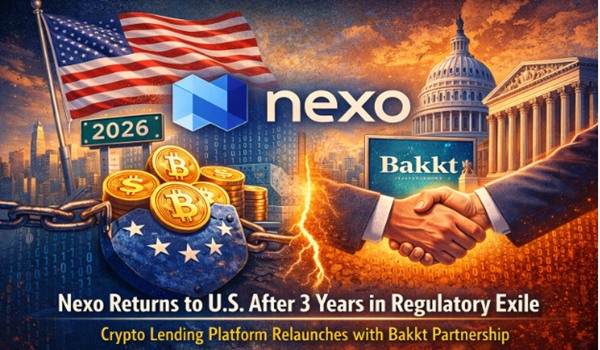
The comeback follows sweeping legal clarification in 2025 that defined stablecoins, digital commodities oversight, and bank custody treatment. For lenders that once fled the jurisdiction, the United States now appears less like a legal minefield and more like a structured marketplace.
The relaunch also reflects a broader industry reset after the failures of Celsius and BlockFi. Yield products remain available, but with tighter risk controls and regulatory alignment.
The significance goes beyond a single company. Firms are returning not because the rules disappeared but because they finally exist.
3. Polymarket Starts Selling Information
Prediction market platform Polymarket acquired API startup Dome, signaling a shift from trading venue to financial data provider.
By allowing developers and institutions to plug directly into real-time probability feeds, the company aims to distribute expectations data across trading systems, analytics dashboards, and research tools. Prices in prediction markets increasingly function like forward-looking economic indicators rather than entertainment wagers.

This mirrors how traditional exchanges make more from data than transactions. Instead of charging users to place bets, the platform may profit from selling structured forecasts about elections, inflation, and geopolitical events.
The transition suggests prediction markets are becoming part of the information infrastructure that financial decision-making depends on.
4. Robinhood Tests Becoming a Blockchain Network
Robinhood’s new Ethereum layer-2 testnet processed roughly four million transactions in its first week, offering an early look at its plan to move beyond brokerage services into settlement infrastructure.
The company wants users not just to trade assets in its app but to actually hold tokenized assets on a blockchain connected to their accounts. If successful, ownership would exist on a public ledger rather than internal databases.

This places Robinhood in competition not only with brokers but with blockchains themselves. Exchanges historically handled trading while networks handled settlement; the firm is attempting to merge both roles.
The strategy reflects a wider industry shift where platforms compete to become the rails financial markets run on, not merely the interfaces investors use.
5. Crypto Payments Surface in International Spy Case
In one of the week’s most unusual intersections of finance and security, prosecutors alleged $1.26 million in cryptocurrency funded the sale of classified cyber-exploit tools tied to the Five Eyes intelligence alliance.

Investigators reconstructed the transactions through blockchain analysis, later linking funds to property purchases and other assets. The case highlights a recurring reality: crypto allows cross-border payments without banks, but it also leaves a permanent forensic trail.
Authorities view the incident less as a monetary crime and more as a strategic breach, since leaked exploit software can neutralize years of intelligence advantage once exposed.
The episode reinforces how digital assets now appear regularly in national security investigations rather than just financial fraud cases.


 eabungana@gmail.com
