





 Crypto News – Weekly Recap – March 21, 2026
 Weekly Recap: Regulatory Crackdowns, Policy Shifts, Market Delays, and Infrastructure Expansion
This week illustrated crypto’s maturing but still-fragile position at the intersection of regulation, market cycles, and geopolitics.
Enforcement actions like Argentina’s highlight persistent challenges for borderless platforms, while withdrawals and delays reflect pragmatic adaptation to uncertain conditions. At the same time, progress on the digital euro shows institutions actively building infrastructure for mainstream integration.
As adoption grows unevenly, balancing innovation with compliance and external stability will remain central to the sector’s trajectory.
European Central Bank Advances Digital Euro Integration Plans
The ECB took a concrete step toward launching the digital euro by inviting industry experts to help design how it will function across ATMs and point-of-sale terminals.
Two new workstreams, focused on technical implementation and certification, aim to ensure the digital euro integrates seamlessly with existing infrastructure. The goal is to avoid costly hardware upgrades while enabling features such as offline payments.

The scale of the challenge is significant. As of mid-2025, the euro area had approximately 249,300 ATMs and 24.7 million POS terminals, most of which already support contactless payments. The digital euro must operate across this network without disrupting current systems.
Estimated development costs stand at €1.3 billion, with annual operating expenses projected at €320 million. Decisions made now, particularly around integration and certification, will determine how efficiently the system can scale.
Argentina Orders Nationwide Block of Polymarket
Argentina moved decisively against prediction market platform Polymarket, ordering internet service providers to block access and directing Apple and Google to remove the app from local stores. The decision followed a regulatory investigation that found the platform was operating without authorization under Argentina’s gambling and financial laws.

Polymarket operates as a decentralized application without a clear legal entity in each jurisdiction, complicating enforcement. By targeting distribution channels like app stores and mandating ISP-level restrictions, regulators effectively limited mainstream access despite the platform’s continued technical availability online.
The move reflects a growing global trend: regulators are applying existing laws to blockchain-based services rather than waiting for new frameworks, particularly when those services intersect with betting or financial activity.
DeFi Lobby Drops SEC Airdrop Lawsuit
A closely watched lawsuit challenging how U.S. securities law applies to token airdrops has been withdrawn by the DeFi Education Fund and Beba.
The lawsuit, filed in 2024, targeted the SEC’s use of the Howey Test to classify digital assets. Plaintiffs argued that airdrops designed to decentralize network ownership, rather than raise capital, should not automatically qualify as securities.
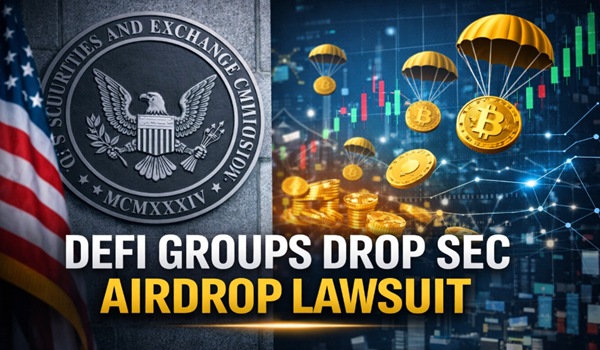
Airdrops remain a major onboarding tool in decentralized finance. Uniswap’s 2020 distribution, for example, reached approximately $6.4 billion in peak token value. Yet regulatory uncertainty has had measurable effects: between 2022 and 2024, more than 30% of major airdrops excluded U.S. users due to legal risk.
Instead of pursuing lengthy litigation, industry groups now appear to favor direct policy engagement.
OpenSea Delays SEA Token Launch as NFT Market Weakens
OpenSea postponed the launch of its SEA token, signaling persistent weakness across the NFT market rather than a company-specific issue.
Monthly NFT trading volumes, which exceeded $6 billion during the 2021 peak, now struggle to remain above $1 billion in 2026. Active wallet participation and average asset prices have also declined, signaling weaker retail engagement.

A token launch in this environment carries significant risks. Marketplace tokens depend on strong transaction activity to sustain value, and weak conditions can lead to low adoption and price instability.
The delay aligns with a broader industry pattern. Illuvium has postponed elements of its token-linked ecosystem rollout, zkSync has delayed aspects of its token distribution, and Yuga Labs has scaled back token expansion tied to its Otherside project.
For OpenSea, timing has become critical. A delayed launch may preserve long-term positioning, but it also gives competitors more time to consolidate their advantage in an already competitive market.
TOKEN2049 Dubai Postponed to 2027
One of the largest global crypto conferences, TOKEN2049 Dubai has been postponed from April 2026 to April 21–22, 2027, following a safety review linked to regional geopolitical tensions.
The event was expected to host more than 15,000 attendees, over 4,000 companies, and participants from 160 countries, alongside 200 speakers and exhibitors. Organizers opted to delay rather than risk disruptions to travel and logistics.
All purchased tickets remain valid for 2027, with an option for attendees to transfer to the Singapore edition later in 2026. The postponement highlights the vulnerability of large in-person events to geopolitical conditions.
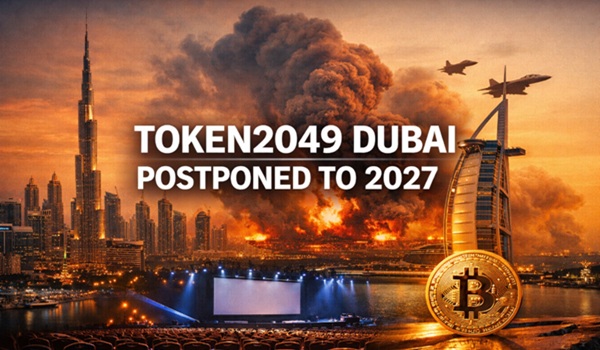
Reports of missile and drone activity affecting the broader Middle East have increased caution around international travel and event planning.
While Dubai remains a major crypto hub with a supportive regulatory environment, the decision highlights how external factors can influence even the most established industry gatherings.