



 ECB Moves to Integrate Digital Euro Payments

Technical Foundations: The G5 and B1 Workstreams
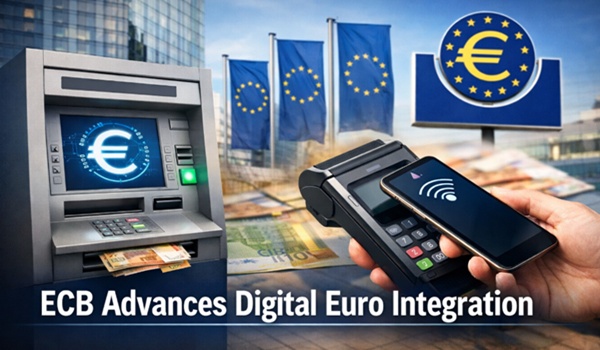
The first workstream, labelled G5, focuses squarely on implementation specifications for ATM and terminal providers.
Participants must bring deep knowledge of how these machines communicate, support different technologies, handle offline transactions, and reuse current industry standards.
The second, B1, concentrates on building a testing and certification framework for every payment and acceptance device that will interact with the new currency. Both groups report to the broader Rulebook Development Group, which already includes representatives from consumers, retailers, and payment service providers.
A Pivotal Timeline: From Preparation to Pilot
This recruitment comes at a pivotal moment in the project’s timeline. The two-year preparation phase wrapped up in October 2025 after the Eurosystem finalised a draft rulebook, selected potential platform providers, and ran extensive experiments.
Since November 2025, the work has shifted into a modular readiness phase designed to keep momentum even while legislation advances.
European Council ministers reached a common position in December 2025. Parliament is expected to finalise its stance around May, opening the door for trialogue negotiations.
If the regulation passes in the course of 2026, the Eurosystem aims to start a controlled pilot with real transactions in the second half of 2027 and stand ready for the first issuance during 2029.
Integrating with a Massive Retail Infrastructure
At the end of the first half of 2025, the euro area operated roughly 249,300 automated teller machines, down 2.9 percent from a year earlier but still forming the backbone of cash access for hundreds of millions of citizens.
Point-of-sale terminals numbered 24.7 million, a striking 24 percent increase year on year as contactless payments continue their rapid spread.
Almost all of those terminals already accept contactless cards, and 34 percent of ATMs do the same. The digital euro must plug into this landscape so that a customer can tap a phone or card at any terminal or withdraw physical cash at any machine using the new central bank money.
The Challenge of Offline Resilience and Cost-Efficiency
Offline functionality sits at the heart of the technical challenge. Workstream G5 will examine how terminals and ATMs can complete digital euro payments when internet connections drop, a feature the ECB has repeatedly emphasised as essential for resilience and inclusion.
Reusing existing communication protocols and hardware standards is equally important. Forcing every provider to rip out and replace equipment would raise costs dramatically and slow adoption.
Standardizing Certification Across the Euro Area
Certification requirements add another layer. Workstream B1 will design the approval process that every payment solution and infrastructure component must pass before it can handle digital euro transactions.
This framework must cover both the devices themselves and the software that payment service providers run. The aim is uniform testing across the entire euro area so that a solution certified in one country works everywhere else.
Economic Scale and Market Engagement
The Eurosystem estimates total development costs to reach about €1.3 billion by the time of first issuance, with subsequent annual operating expenses projected near €320 million.
Those figures cover both internal work and external components. Every decision on ATM and terminal integration directly influences how much of that budget goes toward new hardware versus clever software adaptations.
The move fits a broader pattern of market engagement that began during the preparation phase. The Rulebook Development Group has steadily gathered input from merchants and banks on how the digital euro should sit alongside existing payment rails such as TARGET and TIPS.
Recent European Retail Payments Board discussions in early 2026 explored simplification, co-badging, and cost-sharing arrangements.
Applications for the two workstreams close on April 10. Candidates need to submit a CV and meet the eligibility criteria spelled out in the official calls. Where relevant, a letter of support from an existing Rulebook Development Group member strengthens the file.
The ECB will review submissions quickly so the selected experts can begin shaping the rulebook proposals in the coming months.
For the millions who rely on ATMs for cash and terminals for everyday purchases, these seemingly technical workstreams carry practical consequences. If the experts succeed, the digital euro will arrive not as a parallel system but as a natural extension of infrastructure already in place.
Merchants will avoid major capital expenditure. Banks will integrate more easily. Consumers will gain another reliable way to pay with public money in both online and offline settings.
The recruitment drive, therefore, marks a concrete step toward ensuring that, whenever the digital euro launches, the euro area’s payment fabric is ready to carry it without friction.