





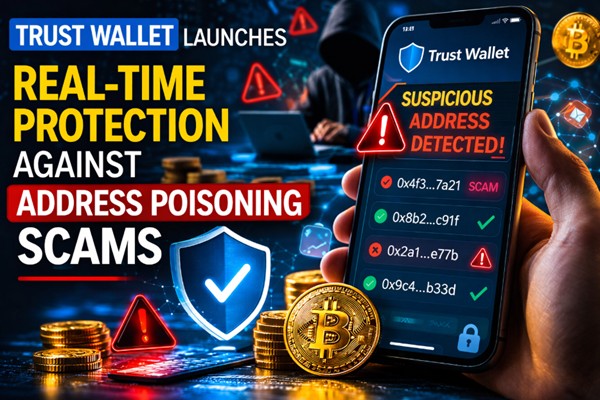
 Trust Wallet Launches Real-Time Protection Against Address Poisoning Scams
  Article Contributors

 Fact checked by

Combatting Address Poisoning and Social-Engineering Scams
The feature, rolled out as part of the wallet’s latest security upgrade, scans wallet interactions and flags suspicious addresses linked to known scams or patterns associated with address poisoning. The move reflects a broader industry push to address social-engineering attacks that exploit user behavior rather than vulnerabilities in blockchain infrastructure.
Address poisoning has emerged as a common attack method in decentralized finance and everyday crypto transfers. The tactic relies on the fact that many users copy and paste wallet addresses from their transaction history when sending funds.
Attackers generate wallet addresses that closely resemble legitimate ones, often matching the first and last characters of a commonly used address. They then send a small or negligible transaction to a target wallet, causing the fake address to appear in the user’s transaction history. When the victim later copies an address from that history, they may accidentally select the malicious one.
Because blockchain transactions are irreversible, the result is often permanent loss of funds.
Analysis of on-chain activity has identified more than 270 million address poisoning attempts targeting over 17 million wallets, with at least $83.8 million in confirmed losses across networks, including Ethereum and BNB Chain. In one widely cited case, a trader mistakenly sent nearly $50 million in USDT on December 20, 2025, after copying a poisoned address during a large transfer.
These incidents illustrate a broader challenge in crypto security. Unlike hacks that exploit code vulnerabilities, address poisoning relies almost entirely on human error.
How Trust Wallet’s Protection Works
Trust Wallet’s new protection feature focuses on intercepting risky transactions before they are finalized. When a user attempts to send crypto to an address that shows characteristics associated with address poisoning or is linked to known scam activity, the wallet issues an immediate warning.
The system checks the destination address against security intelligence and behavioral indicators tied to malicious activity. Suspicious addresses can then be flagged directly within the wallet interface, prompting users to verify the destination before confirming the transaction.
The feature also warns users about addresses that appear only in incoming transactions but have not previously been used as legitimate recipients. This is a common pattern in poisoning attacks, where attackers insert their addresses into transaction histories through tiny deposits.
Security alerts appear during the transaction review stage, a point where users can still cancel the transfer.
The company says the feature is designed to operate automatically without requiring additional configuration from users, reflecting the increasing emphasis on built-in wallet security.
Rising Losses From Crypto Scams
The release comes as crypto scams continue to generate billions of dollars in losses each year. Bitedge’s investigations estimate that total crypto-related theft and fraud reached approximately $3.4 billion in 2025, with a large share linked to social-engineering attacks rather than technical exploits.
Address poisoning represents a relatively small but growing portion of those losses. The attacks are attractive to criminals because they are inexpensive to execute and require no sophisticated hacking tools.
The approach also scales efficiently. Bots can automatically monitor blockchain activity to identify active wallets that frequently send funds, increasing the likelihood that victims will reuse addresses from their recent transaction logs.
Security Tools Becoming Standard
Wallet providers and blockchain infrastructure companies have begun developing tools aimed at detecting or preventing these attacks. Some security platforms now monitor addresses against databases of wallets associated with phishing or scams, while others focus on transaction pattern analysis.
Trust Wallet’s new feature fits into this broader effort to integrate security intelligence directly into user interfaces.
Self-custody wallets remain central to the crypto ecosystem because they allow users to hold private keys without relying on centralized exchanges. However, the model also places greater responsibility on individuals to verify transactions and maintain operational security.
Industry Push Toward Safer Self-Custody
The launch of real-time address checks highlights a shift in wallet design priorities. Earlier generations of crypto wallets focused primarily on access and compatibility across blockchains. More recent updates emphasize automated safety checks to help users avoid common mistakes.
Trust Wallet, which supports over 200 million users and hundreds of blockchain networks, has steadily expanded its security toolkit in recent years with transaction simulation, smart-contract risk analysis, and phishing protection features.
As the crypto ecosystem expands and more users interact with decentralized applications, security measures built into everyday tools may play an increasingly important role in preventing fraud.




 eabungana@gmail.com
