





 Render (RNDR) Price Prediction
  Article Contributors

 Fact checked by

Render Price Prediction Analysis (Today → Long-Term)
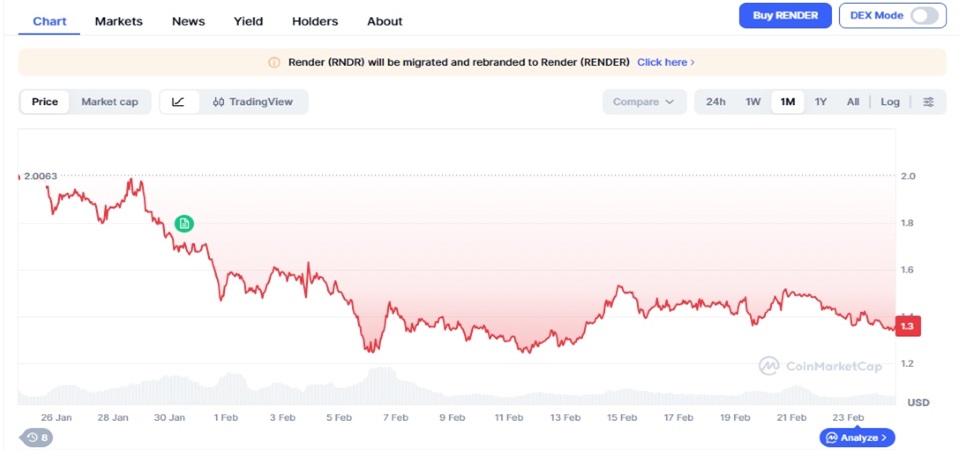
Render (RNDR) is currently trading between $1.35 and $1.47, with a market capitalization near $763 million, securing its position as the 79th-ranked cryptocurrency. The token has posted a modest gain of over 8% today, though, like most digital assets, it remains sensitive to broader market sentiment and macroeconomic conditions.
What distinguishes Render from general-purpose layer-1 blockchains is its tangible utility. Rather than relying on a “store of value” narrative, RNDR functions as the native fuel for a decentralized GPU marketplace. Users burn RNDR tokens to access rendering services, while node operators earn them by contributing idle hardware.
To date, the network has processed over 68 million rendered frames through approximately 5,600 active GPU nodes globally. These are fundamental metrics that arguably carry more weight than short-term price speculation.
The project’s migration to Solana marked a significant infrastructure upgrade, delivering faster transaction finality and reduced fees that make the platform more viable for enterprise-scale workloads . Looking ahead, key catalysts include the trajectory of AI adoption, sustained GPU demand, and Render’s ability to capture meaningful market share within the broader cloud computing sector.
Short-Term Render Forecast
In the short term, RNDR’s price action is mostly tied to macro crypto sentiment. When Bitcoin and Ethereum rally, altcoins, including RNDR, often benefit from increased liquidity and investor rotation. Conversely, risk-off environments can suppress speculative interest.
This volatility is a focal point in recent cryptocurrency predictions, which highlight how utility-driven assets react to shifting liquidity. Understanding these cycles helps clarify why technical levels like those below are so critical for traders.
Key technical levels for short-term traders include support around $1.35, meaningful near-term resistance near $1.75, and psychological resistance around $2.00. Volatility remains elevated, as reflected in trading volumes and active addresses, signaling mixed but engaged participation.
Short-term price prediction for the next few months should be treated as noise. The long-term fundamental trends, including usage adoption and ecosystem growth, will have a stronger effect on price in the medium to long term.
Render Prediction Table (2026–2040)
| Year | Pessimistic Case | Realistic Case | Optimistic Case |
| 2026 | $1.28 | $2.11 | $2.74 |
| 2027 | $2.78 | $3.82 | $5.10 |
| 2028 | $5.15 | $6.91 | $9.02 |
| 2029 | $9.08 | $11.93 | $15.31 |
| 2030 | $15.35 | $19.79 | $25.02 |
| 2031 | $22.50 | $28.04 | $35.13 |
| 2032 | $30.82 | $38.06 | $48.53 |
| 2033 | $40.11 | $52.45 | $68.39 |
| 2034 | $55.98 | 72.22 | $95.89 |
| 2035 | $75.10 | $98.75 | $130.17 |
| 2036 | $100.24 | $135.90 | $180.38 |
| 2037 | $135.59 | $185.92 | $245.46 |
| 2038 | $180.83 | $250.81 | $330.27 |
| 2039 | $240.23 | $340.54 | $450.95 |
| 2040 | $320.11 | $460.28 | $600.01 |
Keep in mind these ranges are just scenario estimates. Do your own research before making any investment decision.
Render Price Prediction 2026
So what about this year specifically? The question on everybody’s mind is whether Render can build on its head start in decentralized rendering. Most analysts think we’re looking at an average around $2.11, with a bull case hitting $2.74 if AI interest picks back up and new partnerships materialize.
The downside case sits near $1.28, assuming macro conditions remain rough. Keep an eye on the AI compute platform and whether any major studios start using the network.
Render Price Prediction 2027
If Render manages to pivot from just 3D rendering toward more AI inference work, demand could really start accelerating by 2027.
The network might be processing way more frames and AI jobs by then. Realistic targets around $3.82 seem reasonable, and if the AI crypto narrative catches fire again, $5.10 isn’t out of reach.
That said, more DePIN projects are popping up daily, so competition could keep things in check. Worst case, maybe $2.78.
Render Price Forecast 2028
By 2028, we might start seeing bigger players getting involved. If major VFX studios or AI research labs integrate Render into their pipelines, the demand shifts from speculation to actual utility.
Forecasts put prices anywhere from a low of $5.15 to a high of $9.02 in a bullish year, with a realistic middle ground near $6.91. Scaling and keeping fees low will matter more than ever at this stage.
Render Price Prediction 2030
Looking out to 2030, the big question is whether Render has become standard equipment for content creators and AI developers.
If decentralized compute grabs even a small chunk of the cloud market, RNDR could see real appreciation.
Realistic estimates around $19.79 make sense, with upside to $25.02 if things go well. The more pessimistic view, where adoption drags, puts prices near $15.35.
Render Price Outlook 2040
Honestly, predicting anything 15 years out is kind of wild. But the potential market for GPU computing is enormous. If Render ends up as backbone infrastructure for the metaverse, real-time rendering, and widespread AI, token demand could be massive.
A pessimistic case may be around $320.11, accounting for competition and tech shifts. A realistic scenario with a decent market share might see $400–500, while an optimistic play where Render dominates a multi-trillion-dollar digital economy could possibly be $600.01.
The Render Network
Unlike purely speculative tokens, RNDR functions as a payment mechanism within a working decentralized compute marketplace.
The Render Network connects GPU owners with creators and AI developers. Jobs are verified via a proof-of-render system before token settlement, ensuring efficiency and reducing fraud.
Following its migration to Solana, transaction speed improved significantly while reducing costs. This transition enhanced scalability and positioned Render competitively in the decentralized infrastructure sector.
The trade-off lies in balancing decentralization with performance. Render prioritizes real-world usability while maintaining blockchain transparency. To engage with the network safely, users rely on crypto wallets
that provide direct control over their digital assets
What Drives Render’s Price?
RNDR currently trades approximately 70% below its all-time high recorded during the 2021–2022 bull cycle. While upside remains possible, its price behavior depends on several core drivers.
Regulation & Legal News
As far as anyone can tell, regulators like the SEC aren’t poking around Render. That’s good, as it lets the team focus on building instead of legal battles. But broader AI and crypto regulations could still affect things down the road.
Institutional Adoption & AI Narrative
This is the big one. Render’s connections run deep, including OTOY (which works closely with Apple’s Vision Pro) and appearances at NVIDIA’s GTC conference. The advisory board’s stacked too with Beeple, J.J. Abrams, and Emad Mostaque. If Hollywood or major gaming companies start relying on Render, demand could go through the roof.
Supply & Token Release Dynamics
The Burn-Mint thing cuts both ways. Burns reduce supply, which is bullish, but right now emissions from node rewards are outpacing those burns. So there’s net inflation. For real price appreciation to happen, usage burns need to consistently beat new supply. That means adoption has to grow like crazy.
Market Dynamics
RNDR moves with the broader crypto market like most altcoins. When Bitcoin’s pumping and greed is high, money flows into riskier AI tokens across various cryptocurrency exchanges. When things get shaky, RNDR drops hard. It’s also tied to whatever hype cycle AI happens to be in at the moment.
How High Can Render Go? Price Targets Explained
Since Render focuses on GPU computing specifically, its price potential connects directly to how big those industries get.
Can Render Reach $10?
Yes, it can. That’s a realistic target for 2029-2030 based on our numbers, somewhere between $11 and $15. Getting to $10 means steady adoption from 3D and AI communities, putting its market cap in line with other infrastructure projects. The next bull run could easily take it there.
Can Render Reach $100?
Now that’s tougher, but possible long-term. For RNDR to hit $100, the market cap would need to hit roughly $50 billion. That means Render isn’t just participating. It’s leading the decentralized compute space, taking serious market share from AWS and Google Cloud for rendering and AI work. Think late 2030s for this one.
Will Render Hit $600? (Market Cap Reality Check)
$600 is the dream scenario for 2040, and it can be achievable in this volatile crypto market. We’re talking about a $300 billion market cap, which puts it among the world’s most valuable assets.
For that to happen, Render would need to be the default processing layer for a massive metaverse or essential infrastructure for general-purpose AI powering huge chunks of the digital economy.
It’s possible if digital content creation becomes as common as social media, but definitely not the baseline expectation.
Risks & Disclaimer
All price predictions are speculative by nature. The cryptocurrency market is notoriously volatile, and Render (RNDR) is no exception. Prices can swing sharply based on market sentiment, broader crypto trends, regulatory shifts, and technological developments.
While Render’s utility in AI and decentralized computing offers a strong fundamental case, there are no guarantees. Competition from centralized cloud providers and other DePIN projects remains fierce. Tokenomics also play a role—if network usage (burns) does not outpace node rewards (emissions), price appreciation may be limited.
Readers should treat these forecasts as educational scenarios, not financial guarantees. Always conduct your own research and consider consulting a financial professional before making investment decisions.
Conclusion
Render’s long-term outlook spans a wide range of scenarios. A base case sees steady growth, supported by increasing demand for GPU power in AI and 3D rendering. A bullish path could unfold if Render becomes critical infrastructure for the metaverse and AI compute, driving sustained demand.
The bear case accounts for intense competition, slower adoption, or unfavorable regulation limiting upside.
The biggest drivers to watch are network usage, the burn-to-emission ratio, and enterprise partnerships. For more insights, explore our crypto hub and other cryptocurrency price predictions.
More Crypto Price Prediction Pages

Frequently Asked Questions
What is the Render price prediction for 2026?
Most analysts figure RNDR averages around $2.11 in 2026, probably trading somewhere between $1.28 on the low end and $2.74 if things get really bullish. All these depend on whether AI narratives pick back up and if Render lands any big partnerships
What is the Render price prediction for 2030?
By 2030, the realistic average sits around $19.79, with a range spanning $15.35 to $25.02. This assumes decent adoption but not world-changing growth. The optimistic side obviously requires more.
What could Render be worth in 2040?
Honestly, it’s anyone’s guess that far out. Optimistic scenarios toss around $600.01 or more, but that depends on AI and metaverse adoption going completely mainstream. Realistically, maybe $460.28 if they capture decent market share.
How much will Render be worth in 5 years?
Five years from now (around 2030), probably $15 to $25, depending on how well they capture the AI and rendering markets.
Can Render reach $10, $100, $600?
Yes. To $10, that’s totally realistic by 2029-2030. To $100, that’s tougher but possible by the late 2030s if Render leads in decentralized compute. It can also reach $600, but not in the coming three or four years. Maybe in 2040, when they dominate a massive digital economy. Anything is possible in the crypto landscape.
Is Render a good investment?
Absolutely. However, your choice depends on what you’re looking for. Render’s got real utility in AI and DePIN, which is more than a lot of projects offer. It’s high-risk, high-reward, and tied to tech adoption and market cycles. Consider this investment if you have a high risk tolerance and are looking for long-term horizons.
Why is Render rising/falling?
It usually tracks with overall crypto market vibes, the hype around AI tokens, and specific news about partnerships or network upgrades. Right now, it’s down with everything else.
Can I use Render in crypto casinos?
Yes. Some crypto casinos might accept it, but that’s not really what it’s for. Render’s designed for buying GPU computing power, not everyday payments.
Sources

 eabungana@gmail.com
He has worked with several companies in the past including Economy Watch, and Milkroad. Finds writing for BitEdge highly satisfying as he gets an opportunity to share his knowledge with a broad community of gamblers.
Nationality
Kenyan
Lives In
Cape Town
University
Kenyatta University and USIU
Degree
Economics, Finance and Journalism


Facts Checked by Josip Putarek