





 Fantom (FTM) Price Prediction


 Fact checked by

Sonic Price Prediction Analysis (Today → Long-Term)
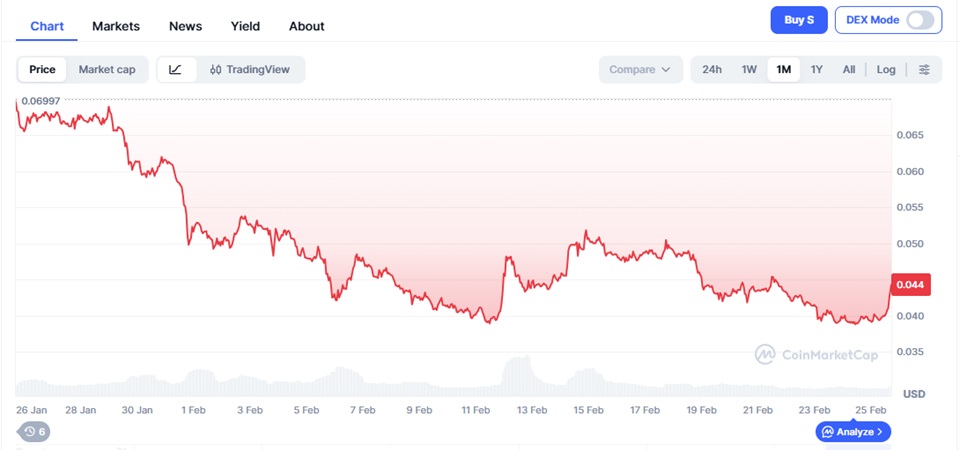
Sonic (S) is currently trading between $0.038 and $0.045, with a market capitalization of approximatelly $113 million, ranking it around 174th among cryptocurrencies. The token has struggled since its January 2025 launch, down over 95% from its all-time high of $1.03 reached shortly after migration.
This decline reflects both broader market corrections and the challenge of rebuilding ecosystem momentum post-migration.
What makes Sonic different from other Layer-1 blockchains is its complete architectural overhaul they did. The network now features the Sonic Virtual Machine (SVM) and an optimized database setup. It enables theoretical throughput of up to 400,000 transactions per second with sub-second finality, placing it among the fastest EVM-compatible chains in existence.
The migration timeline unfolded as follows:
- December 2024: Sonic mainnet launched
- January 13, 2025: FTM deposits/withdrawals suspended on major exchanges
- January 16, 2025: Sonic (S) trading began on Binance and other platforms
- May 2025: Migration completed on Kraken
The conversion was pretty seamless for holders: 1 FTM = 1 S, with automatic conversion on exchanges. However, the old Fantom Opera chain remains accessible for historical purposes, while all new ecosystem activity is supposed to occur on Sonic moving forward.
Looking ahead, key catalysts include the success of Sonic’s new Fee Monetization (FeeM) model (where developers earn up to 90% of the fees their apps generate), the vertical integration strategy focused on building or acquiring core applications, and potential institutional adoption through that proposed TradFi expansion plan they’ve been talking about.
Short-Term Sonic Forecast
In the short term, S’s price action is mostly tied to macro crypto sentiment and the market’s perception of Sonic’s post-migration execution. Technical indicators currently show bearish momentum, with price trading within a descending channel and making lower lows, which isn’t great.
Key technical levels for short-term traders include:
- Support: $0.036–$0.038 (recent all-time low zone)
- Resistance: $0.054–$0.060 (former support and trendline resistance)
- Psychological resistance: $0.10 (round number)
The RSI recently touched 28, approaching oversold territory, which could signal a potential relief bounce if buyers ever step in. However, the broader trend remains bearish until price breaks above that descending trendline thing.
The Fear & Greed Index currently sits at 8 (“Extreme Fear”), reflecting broader market caution for sure. With Bitcoin dominance elevated, capital is not really rotating into altcoins like S right now. For a sustained uptrend, Sonic needs to demonstrate tangible ecosystem growth and developer adoption, which is easier said than done.
That being said, short-term Sonic price predictions for the next few months should not be relied upon too heavily. The long-term fundamental trends, including FeeM adoption, vertical integration execution, and ecosystem growth, will have a stronger effect on price over medium to long horizons.
Sonic Prediction Table (2026–2040)
| Year | Pessimistic Case | Realistic Case | Optimistic Case |
| 2026 | $0.022 | $0.097 | $0.28 |
| 2027 | $0.09 | $0.24 | $0.52 |
| 2028 | $0.15 | $0.39 | $0.78 |
| 2029 | $0.31 | $0.64 | $1.05 |
| 2030 | $0.43 | $0.99 | $1.50 |
| 2031 | $0.55 | $1.22 | $2.11 |
| 2032 | $0.65 | $1.59 | $2.81 |
| 2033 | $0.82 | $1.94 | $3.64 |
| 2034 | $1.04 | $2.33 | $4.56 |
| 2035 | $1.23 | $2.88 | $5.53 |
| 2036 | $1.57 | $3.44 | $6.89 |
| 2037 | $1.88 | $4.12 | $8.25 |
| 2038 | $2.23 | $4.95 | $10.08 |
| 2039 | $2.77 | $5.86 | $12.56 |
| 2040 | $3.33 | $7.03 | $15.09 |
Note that these ranges are scenario estimates based on ecosystem recovery, developer adoption, and market cap constraints.
Conduct additional research first before making any investment decision, and check the following guides:
Sonic Price Prediction 2026
The key question for 2026 is whether Sonic can translate its technological advantages into measurable ecosystem growth. Most analysts project a range between $0.022 and $0.28, with a realistic average near $0.097.
The bull case reaching $0.28 requires successful FeeM adoption, new dApp launches, and broader DeFi recovery.
The downside case sits near $0.022, assuming continued ecosystem stagnation and macro headwinds persist. Watch for developer activity metrics, new protocol launches, and any announcements regarding the TradFi expansion plan.
Sonic Price Prediction 2027
If Sonic successfully executes its vertical integration strategy, like building or acquiring core applications to capture value, demand could stabilize by 2027, hopefully.
Realistic targets around $0.24 seem reasonable enough, with $0.52 possible if DeFi activity rebounds and the FeeM model finally gains some traction.
However, competition from other fast chains remains intense as always. The downside case sits near $0.09, which isn’t great.
Sonic Price Forecast 2028
By 2028, the impact of Sonic’s Fee Monetization model could become more pronounced, you’d think. The protocol burns 50–90% of transaction fees, creating deflationary pressure that could support price appreciation if usage ever scales.
Forecasts range from a low of $0.15 to a bullish $0.78, with a realistic average near $0.39. Sustaining developer mindshare and maintaining competitive throughput will be critical at this stage.
Sonic Price Prediction 2030
Looking toward 2030, the central question is whether Sonic has established itself as a competitive smart contract platform with meaningful DeFi adoption. If the network captures even a modest share of the Layer-1 market, S could see significant appreciation.
Realistic estimates around $0.99 make sense, with upside to $1.50 under favorable conditions where the TradFi expansion plan materializes, like they’re hoping. A more pessimistic view, where adoption lags and ecosystem growth stalls, puts prices near $0.40, which would be disappointing.
Sonic Price Outlook 2040
Forecasting 15 years out is inherently uncertain, but Sonic’s technological foundation provides a basis for long-term consideration. The network’s ambitious throughput targets (up to 400,000 TPS) and institutional-focused strategy could position it for significant growth if blockchain adoption achieves mainstream scale.
A pessimistic case accounting for competition and technological shifts sits around $3.30. A realistic scenario with a decent market share might see $7.00. For an optimistic case, where Sonic becomes a leading Layer-1 for DeFi and institutional applications, its value can go up to $15.00 or more.
The Sonic Network
Sonic was rebuilt from the ground up for maximum performance. The network utilizes an optimized Lachesis consensus mechanism with a new Fantom Virtual Machine (FVM) and improved database storage. This architecture delivers:
- Throughput: Up to 400,000 transactions per second (theoretical)
- Finality: Sub-second transaction confirmation
- Fees: Ultra-low, competitive with any Layer 1
- EVM compatibility: Fully compatible with Ethereum tooling
The Fee Monetization (FeeM) model represents a key innovation. Developers earn up to 90% of the fees their applications generate, with the remaining portion burned. This creates aligned incentives for builders to deploy on Sonic.
The Sonic Gateway provides a native, secure bridge to Ethereum, enabling seamless asset transfers between ecosystems. Integration with AggLayer further enhances cross-chain liquidity.
The trade-off involves balancing decentralization with performance. Sonic’s validator set and governance structure prioritize speed and scalability while maintaining sufficient security guarantees.
What Drives Sonic’s Price?
S currently trades approximately 95% below its all-time high of $1.03, recorded in January 2025. While there is growth potential, price behavior depends on several core drivers.
Regulation & Legal News
Regulatory clarity is a cornerstone of Sonic’s institutional strategy. By establishing Sonic USA LLC in Delaware and aligning with frameworks such as the GENIUS Act, the project builds confidence among regulated entities. Clear legal standing encourages exchange listings and opens doors for institutional products like ETFs, directly influencing market confidence and price stability.
Institutional Adoption & Payments Narrative
This is the primary bullish catalyst for Sonic. The project is actively bridging DeFi with TradFi through a $150 million institutional token allocation, including a $100 million Nasdaq PIPE vehicle and partnerships with Galaxy and BitGo. SonicStrategy, a publicly traded company, holds over 171 million S tokens and operates major validators, providing regulated exposure for institutional investors. This “buy-only” philosophy and focus on tokenized capital markets create sustained, long-term demand for S.
Supply & Token Release Dynamics
Sonic employs deflationary mechanics to manage supply pressure. The Fee Monetization (FeeM) upgrade burns 50-90% of transaction fees, reducing circulating supply as network usage grows. Additionally, unclaimed airdrop tokens, approximately 92.2 million S, are being reallocated to targeted incentive programs rather than being dumped on the market, supporting price stability. However, ETF issuance remains paused due to low price conditions, prioritizing scarcity over short-term market access.
Market Dynamics
Broader crypto market cycles heavily influence S’s price. As a high-beta altcoin, S is sensitive to Bitcoin’s performance and macroeconomic sentiment; the recent “Extreme Fear” environment (Fear & Greed Index at 29) has led to capital rotation out of altcoins. Bitcoin’s rising dominance (near 60%) typically suppresses speculative interest in assets like S until a broader shift to risk-on sentiment occurs.
How High Can Sonic Go? Price Targets Explained
Since Sonic focuses specifically on high-throughput DeFi and institutional applications, its price potential connects directly to adoption in these sectors.
Can Sonic Reach $1?
Yes. This represents a realistic target for 2029–2030, representing approximately a 25 times increase from current levels. Reaching $1 requires sustained developer adoption, successful FeeM implementation, and broader DeFi recovery. The next altcoin season could support this level under favorable conditions.
Can Sonic Reach $10?
That’s a tougher but achievable long-term target. For S to hit $10, the market capitalization would need to reach approximately $32 billion. This would require Sonic to become a leading Layer-1 platform, capturing meaningful market share from established competitors and attracting significant institutional adoption. Think late 2030s for this scenario under optimistic assumptions.
Will Sonic Hit $15? (Market Cap Reality Check)
$15 represents the optimistic scenario for 2040, corresponding to a $48+ billion market cap. For this to happen, Sonic would need to become foundational infrastructure for both DeFi and institutional finance, with successful execution of the TradFi expansion plan, widespread developer adoption, and significant user growth. While possible if blockchain achieves mainstream scale, this remains an aspirational rather than a baseline expectation.
Risks & Disclaimer
The cryptocurrency market is notoriously volatile, and Sonic (S) is no exception. All price predictions are speculative by nature and can swing sharply based on market sentiment, broader crypto trends, regulatory shifts, and technological developments.
Specific risks for Sonic include:
- Post-migration execution risk: Rebuilding ecosystem momentum after migration is challenging; adoption remains unproven.
- Competition: Other high-throughput Layer-1s, such as Solana, Avalanche, and more, compete aggressively for developers and liquidity.
- Adoption risk: Despite technological advantages, meaningful user adoption remains below peak Fantom levels.
- Token concentration: The top addresses control a significant supply, creating potential for market manipulation
- Migration confusion: Some users remain confused about FTM vs S, potentially limiting new investor participation
As an investor, understand that these risks may limit Sonic’s price performance. They are not financial guarantees. Ensure you conduct your own research and consider consulting a financial professional before making investment decisions.
Conclusion
For Sonic’s long-term outlook, it spans a bunch of different scenarios tied directly to how they execute after the migration. A base case sees gradual growth, supported by the tech advantages and FeeM model, targeting maybe $7.03 by 2040 if things go according to plan.
A bullish path could unfold if that vertical integration strategy actually works and institutional adoption finally materializes, driving sustained demand toward $15.00 or even higher. The bear case, well, that accounts for continued ecosystem stagnation, intense competition from all those other chains, and failure to regain developer mindshare. This limits upside to around $3.33 or so.
The biggest drivers to watch are FeeM adoption metrics, vertical integration announcements (including potential acquisitions), progress on that TradFi expansion thing, and broader Layer 1 narrative cycles. For more insights, feel free to check out our guides on crypto gambling and other cryptocurrency price predictions.
More Crypto Price Forecasts
Find below additional price predictions for other cryptocurrencies you might be interested in.




























Frequently Asked Questions
What is the Sonic price prediction for 2026?
Most analysts expect S to trade between $0.022 and $0.28 in 2026, with a realistic average near $0.097. These projections depend on ecosystem recovery and whether developer adoption accelerates.
What is the Sonic price prediction for 2030?
By 2030, realistic estimates place S around $0.99, with a range spanning $0.40 to $1.50. This assumes steady DeFi adoption without transformative growth. The optimistic side obviously requires more.
What could Sonic be worth in 2040?
Long-term projections vary widely. Optimistic scenarios suggest $15.00 or more, though this depends on widespread institutional adoption and successful TradFi integration. A realistic scenario with a decent market share might see $7.03, with pessimistic forecasts suggesting potential prices near $3.33.
How much will Sonic be worth in 5 years?
Five years from now (around 2030), S could reasonably trade between $0.99 and $1.50. Of course, this will depend on how effectively the project captures developer mindshare and ecosystem growth.
Can Sonic reach $1 / $10 / $15?
Yes to $1, that’s realistic by 2029–2030 probably. Getting to $10 can be more challenging but achievable by the late 2030s if Sonic becomes a leading Layer-1 platform somehow. For $15, it’s also conceivable by 2040 under an optimistic scenario where institutional adoption accelerates, and the vertical integration strategy actually succeeds, like they’re hoping.
Is Sonic a good investment?
Yes, but honestly, that depends on your objectives and risk tolerance. Sonic offers genuine utility through its high-throughput architecture and innovative FeeM model, which distinguishes it from many Layer-1 competitors out there. However, post-migration adoption remains unproven still, and the project faces intense competition from every direction. It’s high-risk, high-reward, tied to execution and ecosystem growth basically.
Why is Sonic rising/falling?
S typically tracks overall crypto market sentiment, Layer-1 rotation cycles, and specific news about FeeM adoption, vertical integration announcements, or ecosystem partnerships. The post-migration period has been challenging, honestly, with price action reflecting the difficulty of rebuilding everything from scratch, basically.
Can I use Sonic in crypto casinos?
S typically tracks overall crypto market sentiment, Layer-1 rotation cycles, and specific news about FeeM adoption, vertical integration announcements, or ecosystem partnerships. The post-migration period has been challenging, with price action reflecting the difficulty of rebuilding everything from scratch.


 eabungana@gmail.com
